

Text Preprocessing: Named Entity Recognition (NER)
#08 - 100 Days of NLP

Welcome to Day 8 of our 100 Days of NLP adventure! 🌟 Today, we’re stepping into the fascinating world of Named Entity Recognition, or NER for short. This is where your NLP models start to get really smart—by identifying and categorizing entities like names, dates, locations, and more within your text. Ready to start recognizing the big names? Let’s dive in! 🕵️♂️🏢
What is Named Entity Recognition (NER)?

Named Entity Recognition (NER) is a crucial technique in NLP that involves detecting and classifying entities within a text into predefined categories such as person names, organizations, locations, dates, and more. Think of it as your model’s way of highlighting the VIPs (Very Important Parts) in your text!
Example: Consider the sentence: "Apple Inc. was founded by Steve Jobs in Cupertino in 1976."
Here’s what NER does:
"Apple Inc." → Organization
"Steve Jobs" → Person
"Cupertino" → Location
"1976" → Date
Pretty neat, right? Your model can now understand that "Apple" is not just a fruit! 🍎
How Does NER Work?
Text Input: The raw text is input into the NLP pipeline.
Tokenization: The text is split into tokens (words or phrases).
Entity Detection: The model identifies potential entities based on context and patterns.
Entity Classification: Each identified entity is classified into a predefined category (like person, location, etc.)
NER Example Using SpaCy
Let’s look at how SpaCy handles NER with a small code example:
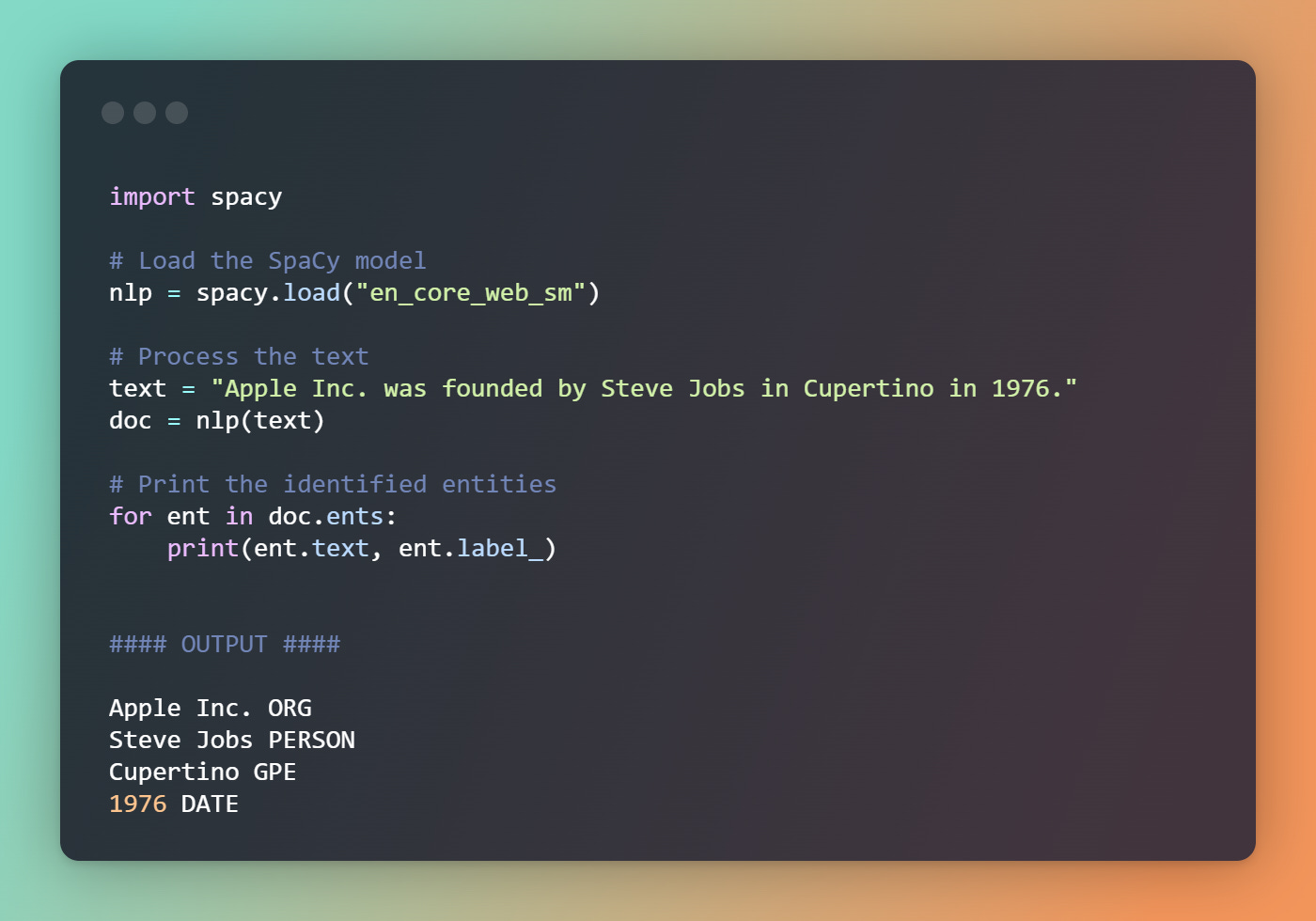
Here, SpaCy’s small model (en_core_web_sm) successfully identifies and categorizes the entities.
Model Size and Its Impact
The performance of NER depends significantly on the model size—whether you’re using a small, medium, or large model. Larger models, trained on more data, typically provide better accuracy and can recognize a broader range of entities. For example:
Small models (e.g.,
en_core_web_sm) are faster but might miss some entities or provide less accurate classifications.Medium and large models (e.g.,
en_core_web_md,en_core_web_lg) offer more detailed and accurate results, especially for complex texts.
Why is NER Important?
Extracting Key Information: NER helps in pulling out important information from large datasets, making it easier to understand and analyze.
Automating Tasks: It’s essential in automating tasks like summarizing news articles, extracting information from legal documents, or organizing customer feedback.
Improving Search Relevance: By recognizing entities, search engines can deliver more relevant results, enhancing the user experience.
Applications of NER
Business Intelligence: Extracting company names, products, and locations from financial reports.
Healthcare: Identifying patient names, diseases, and medications in medical records.
Customer Service: Automatically routing queries based on detected entities like product names or locations.
For instance, in healthcare, NER can be used to automatically identify and categorize symptoms, treatments, and patient information from clinical notes, making data processing more efficient.
And that’s your introduction to Named Entity Recognition! 🎉 If you found this useful, don’t keep it to yourself—share it with others and let’s grow the NLP community together! 🚀📚
Read More:
Keep tagging those VIPs! 🏢✨